The flood insurance gap in the United States is large and not improving. The consequences of that gap are about to worsen for property owners and state and local governments, driven by increasing rainfall, stronger storm surge, more development in flood zones, cutbacks in federal aid, and aging river levees.
That was the assessment from Moody’s Ratings analysts who examined the realities at a webinar Thursday.
“When flood losses happen and they are not absorbed by the shock absorber of insurance, they don’t disappear,” said Firas Saleh, director of insurance solutions and product management at Moody’s.
Some of those costs are shifted onto impacted households that do not carry adequate flood insurance, onto federal assistance programs, and—increasingly—to state and local governments, Saleh said. Government programs are often called upon to pay for debris removal, demolition of flooded structures, bridge replacement, road repairs, and temporary housing.

Local property tax revenue often declines after flooding events as damaged properties lose value. That is especially true in smaller, less-affluent counties and cities, and the decline can affect local credit ratings, costing jurisdictions more to issue bonds and borrow money.
After Hurricane Harvey in 2017, several coastal counties in Texas faced deficits after properties were reassessed and property tax revenue fell, said Denise Rappamund, vice president and senior analyst at Moody’s. Buncombe County, North Carolina—one of the areas hit hardest by Hurricane Helene flooding in 2024—saw its credit outlook rating temporarily downgraded to “negative,” explained Jennifer Chang, Moody’s vice president and senior credit officer.
As the current administration has pursued major cuts to federal funding, including reductions to FEMA programs, cities, counties, and state governments will bear a greater share of infrastructure rebuilding costs after devastating floods, the analysts said.
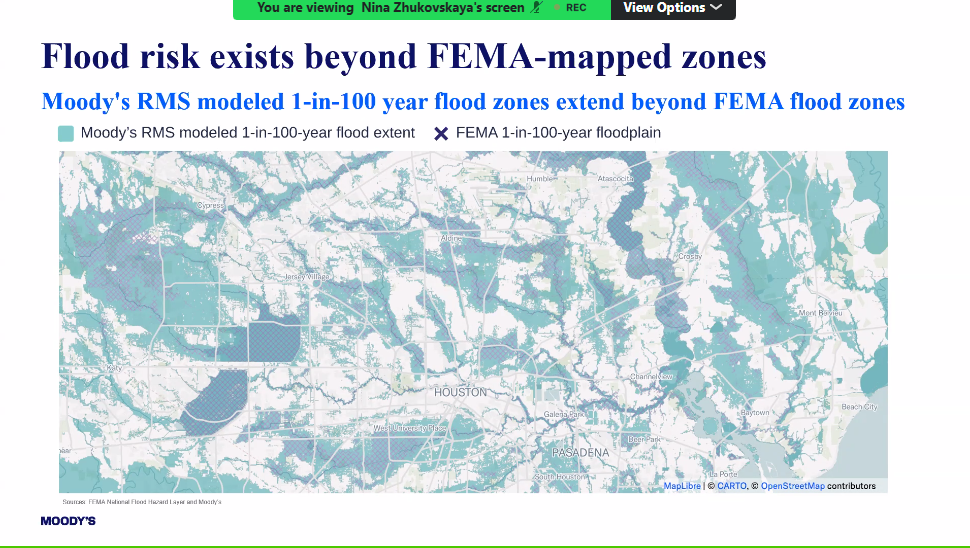 The Houston area. Click to enlarge.
Local governments may also be less financially prepared than they have been in decades. Several states have recently reduced or eliminated their state income taxes, leaving smaller reserves to absorb greater losses. Florida lawmakers this year moved to cut much of the state’s property taxes for homeowners. If approved by voters, that measure could cost local governments as much as $12 billion a year, according to some economists who have raised concerns.
Some of the states that have most embraced federal spending reductions stand to feel the pain most acutely. Texas, Louisiana, Florida, and North Carolina received the most federal disaster aid as a share of overall state revenue from 2017 to 2025. Louisiana led all states, with more than 5% of its revenue derived from federal disaster aid in recent years.
Declining NFIP Participation
Participation in the National Flood Insurance Program has declined significantly, leaving many homeowners more exposed than ever. Approximately 470,000 NFIP policies were lost between 2018 and early 2026. Since 2009, the program has shed 5.6 million policies.

While private flood insurers have stepped in to fill part of that gap, the overall level of U.S. flood coverage has remained roughly flat, Saleh explained.
Flood Maps Understate Risk
Critics of FEMA’s flood maps have long argued they fail to capture the true extent of flood-vulnerable areas. Moody’s computer models bring that shortfall into sharp relief. For the Houston area, a Moody’s map shows a one-in-100-year flood reaching a vastly larger geographic area than FEMA’s maps indicate.
The reach of inland flooding would be even greater if levees fail. Saleh noted that the United States has approximately 100,000 miles of levees, mostly along rivers and lakes, many of which may be increasingly vulnerable to extreme rainfall events. The average age of those levees is 60 years.
Insurer Preparedness Varies
How property-casualty insurers are preparing clients for these growing risks remains unclear and is something analysts and local governments will likely examine in the months and years ahead.
“There’s really a spectrum on how certain insurers are demonstrating what they are doing in terms of resilience, and how much they have invested,” Chang said. Some carriers have developed plans to improve policyholders’ resilience to hazards, while others have not.
Moody’s published report on flood coverage can be accessed here.
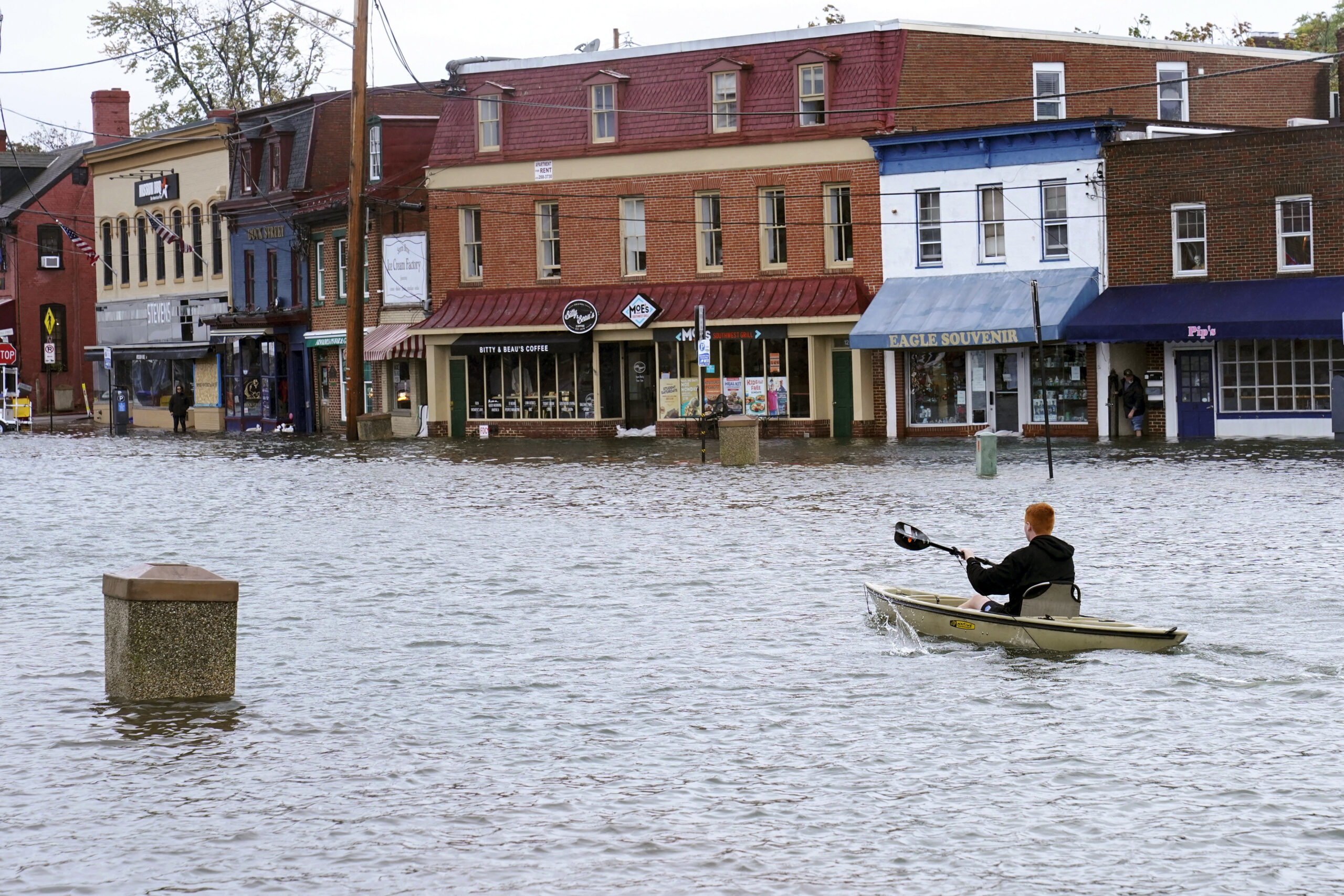
Top photo: Flooding in downtown Annapolis, Maryland, in 2021. (AP Photo/Susan Walsh, File)